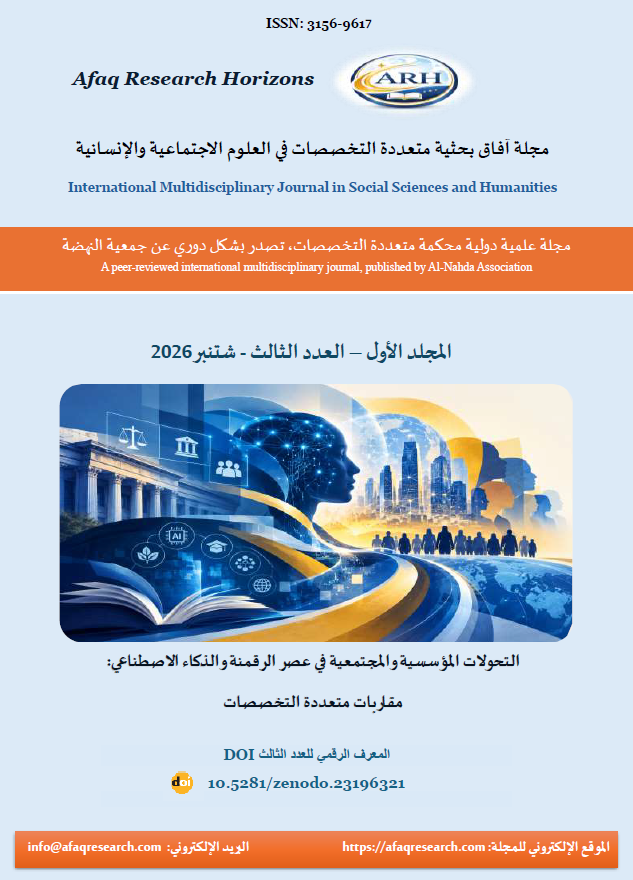
Institutional and Societal Transformations in the Era of Digitalization and Artificial Intelligence: Multidisciplinary Approaches
DOI:
https://doi.org/10.5281/zenodo.23196321Keywords:
Institutional Transformations, Societal Transformations, Digitalization, Artificial Intelligence (AI), Multidisciplinary ApproachesAbstract
The journal Multidisciplinary Research Horizons in Social and Human Sciences presents its third issue to readers and researchers, pursuing its commitment to approaching contemporary issues through cognitive perspectives where education intersects with sociology, and history converges with literature and anthropology. The unifying thread of this issue centers on a core problematic: institutional and societal transformations in the era of digitalization and artificial intelligence, and their impact on pedagogical practices and social configurations. Technology today has become a defining determinant reshaping our identity, educational institutions, social relations, and even our access to essential services.
In this context, the issue opens with a study examining the intersections of digital transformation with instructional practice, reviewing the competency-based approach in teaching the Arabic language within the context of digital transformation, using the "Pioneering Middle School" (Établissements Pionniers) project as an analytical case. This provides an impetus for re-evaluating and refining didactic models, as seen in the article proposing the functional integration of natural sciences and human sciences to develop the teaching of Islamic Education in Moroccan secondary qualifying education.
This educational concern remains inseparable from issues of vulnerable groups and reintegration; the issue highlights the "pedagogy of success in second-chance schools (new generation)" in an effort to comprehend the mechanisms of educational reintegration. Confronted with this instrumental and digital acceleration, a critical and philosophical pause defending the essence of the educational process becomes imperative. This is delivered through an analytical reading of Philippe Meirieu's book, raising the existential question: "Who still wants teachers?", in an overt defense of the teaching profession against the encroachment of artificial intelligence.
Alongside educational and didactic inquiries, the issue engages with questions of society, history, and spatial dynamics. The sociological approach is prominently positioned to question tech-related territorial disparities through an empirical field study on "The Digitalization of Healthcare Services and Citizen Inclusion Amid the Digital Divide and Spatial Disparities" (Driouch Province, the City of Midar as a Case Study), underscoring the urgent need for digital justice alongside social justice. At the intersections of history, education, and values, the issue features a descriptive study investigating the "Epistemology of Universal Values Through the Prophetic Hijra," followed by cross-disciplinary explorations of history and anthropology in "Anthropological Insights from the Black Sea Regions," and a methodological reading of hagiographic literature (Adab al-Manaqib) and how medieval historians utilize hagiographies in historical inquiry. The issue concludes with a perspective on literary criticism and narrative analysis through an applied study examining the "Narrative Structure in the Short Story Collection Rida' al-Zill (The Robe of Shadow) by Youssef Ben Tayeb," addressing thematic dimensions, character dynamics, and the semantics of spatial setting.
We hope the articles in this issue offer a qualitative contribution and open new horizons for rigorous research and scholarly discourse. We take this opportunity to extend our sincere gratitude and appreciation to all researchers who enriched this issue with their valuable contributions, and to the esteemed members of the scientific and editorial boards for their continuous efforts in peer-reviewing and elevating the quality of the published work.
References
بوحشيشة، هـ. (2026). تدريس اللغة العربية بين المقاربة بالكفايات ورهانات التحول الرقمي: إعداديات الريادة أنموذجا. مجلة آفاق بحثية متعددة التخصصات في العلوم الاجتماعية والإنسانية، 1(3)، 1-16. https://doi.org/10.5281/zenodo.23186583
عسيري، ع. (2026). توظيف العلوم الطبيعية والعلوم الإنسانية في تطوير النموذج الديداكتيكي لمادة التربية الإسلامية بالتعليم الثانوي المغربي: نموذج التكامل الوظيفي. مجلة آفاق بحثية متعددة التخصصات في العلوم الاجتماعية والإنسانية، 1(3)، 17-40. https://doi.org/10.5281/zenodo.23186907
رحو، م. (2026). بيداغوجيا النجاح بمدارس "الفرصة الثانية الجيل الجديد". مجلة آفاق بحثية متعددة التخصصات في العلوم الاجتماعية والإنسانية، 1(3)، 41-54. https://doi.org/10.5281/zenodo.23187112
افرماس، م. (2026). دفاعاً عن مهنة التدريس في عصر الذكاء الاصطناعي: قراءة في كتاب فيليب ميريو: "من لا يزال يرغب في أساتذة؟". مجلة آفاق بحثية متعددة التخصصات في العلوم الاجتماعية والإنسانية، 1(3)، 55-71. https://doi.org/10.5281/zenodo.23187323
عاند، م. (2026). ابستمولوجيا القيم الكونية من خلال الهجرة النبوية: دراسة وصفية ديداكتيكية. مجلة آفاق بحثية متعددة التخصصات في العلوم الاجتماعية والإنسانية، 1(3)، 72-93. https://www.doi.org/10.5281/zenodo.23187474
العبدي، ع. (2026). البنية السردية في مجموعة "رداء الضوء" ليوسف بن الطيب: دراسة في التيمات والشخصيات والفضاء المكاني. مجلة آفاق بحثية متعددة التخصصات في العلوم الاجتماعية والإنسانية، 1(3)، 151-172. https://doi.org/10.5281/zenodo.23172877
بلوط، ز. (2026). رقمنة الخدمات الصحية وإدماج المواطنين: مقاربة سوسيولوجية في ظل الفجوة الرقمية والتفاوت المجالي. مجلة آفاق بحثية متعددة التخصصات في العلوم الاجتماعية والإنسانية، 1(3)، 94-126. https://www.doi.org/10.5281/zenodo.23187688
الوحداني، خ. ب. ت. (2026). رؤى أنثروبولوجية في أقاليم البحر الأسود: مشاهدات ثقافية من الشمال التركي. مجلة آفاق بحثية متعددة التخصصات في العلوم الاجتماعية والإنسانية، 1(3)، 127-138. https://doi.org/10.5281/zenodo.23173275
سماعيلي، ر. (2026). المؤرخ وأدب المناقب: المنقبة في خدمة التاريخ - نماذج وسيطية. مجلة آفاق بحثية متعددة التخصصات في العلوم الاجتماعية والإنسانية، 1(3)، 139-150. https://doi.org/10.5281/zenodo.23173100
Downloads
Published
Issue
Section
License
Copyright (c) 2026 AFAQ RESEARCH HORIZONS

This work is licensed under a Creative Commons Attribution 4.0 International License.
تُنشر جميع الأبحاث في مجلة آفاق بحثية متعددة التخصصات في العلوم الاجتماعية والإنسانية بموجب رخصة المشاع الإبداعي نسب المصنف 4.0 دولي (CC BY 4.0).
وتسمح هذه الرخصة بما يلي:
-
نسخ العمل وإعادة توزيعه بأي وسيلة أو صيغة.
-
تعديل العمل أو تطويره أو البناء عليه.
-
استخدام العمل لأغراض غير تجارية أو تجارية.
وذلك شريطة:
-
الإشارة الواضحة إلى اسم المؤلف/المؤلفين.
-
ذكر اسم المجلة كمصدر للنشر الأصلي.
-
إدراج رابط الرخصة.
-
بيان ما إذا تم إجراء أي تعديلات على العمل.
-
عدم الإيحاء بوجود تأييد من المجلة أو المؤلف لأي استخدام لاحق.
تظل حقوق النسبة الأدبية محفوظة للمؤلفين وفق القوانين المعمول بها.


 Latest Announcements
 Important Notice
 Contact Us